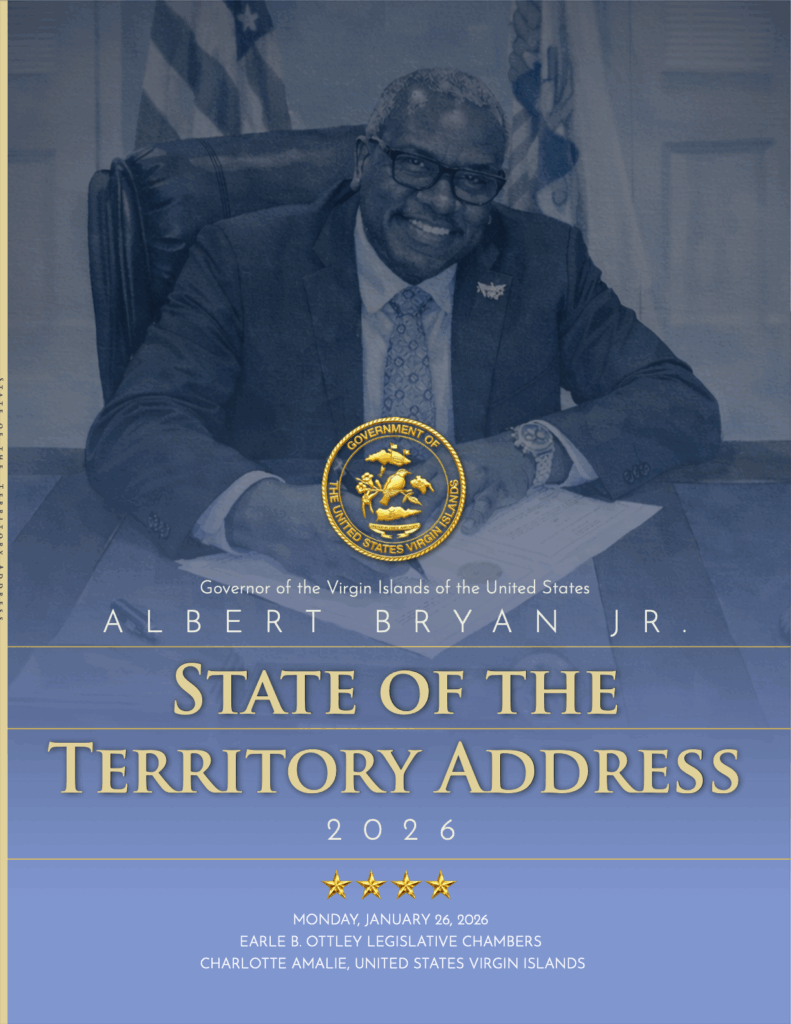
Download the Governor’s 2026 State of the Territory Address
2026 STATE OF THE TERRITORY ADDRESS
Father Anthony Abraham; Lieutenant Governor Tregenza A. Roach, Esq.; Senate President Milton E. Potter and the members of the 36th Legislature; Chief Justice Rhys S. Hodge and the Justices of the Supreme Court of the Virgin Islands; Presiding Judge Jessica Gallivan and the Judges of the Superior Court of the Virgin Islands; Delegate to Congress Stacey Plaskett; members of my Cabinet and agency heads; members of my staff; State Chair of the Democratic Party Carol M. Burke; distinguished guests; and my fellow Virgin Islanders, Good night. Thank you for being here this evening.
Tonight, as your Governor, I stand with gratitude for the people who made this work possible, reverence for the institutions that keep our democracy strong, and an unshakable confidence that our future is bright.
Throughout our seven-year journey, I have gained inspiration from the greatest leadership manual in creation. Proverbs 3:5 and 6 remind us to trust in the Lord with all thine heart and lean not unto thine own understanding. In all thine ways acknowledge him, and he shall direct thy paths. The Most High has guided us safely through another year with an abundance of blessings and without any major disasters or emergencies. For that, we must pause, give thanks, and give praise for those blessings.
These Virgin Islands are built on the shoulders of many great individuals. This last year, we lost several bricklayers of our spirit and culture – Gerville Larsen, Jeavon “Unkle Mehn” Sasso, Louis B. Taylor Jr., Austin “Edgie” Christian Jr., and Attorney Eszart Wynter Sr. We pledge to keep their legacies alive in the way we live, create, and care for one another.
In that same spirit of gratitude and remembrance, join me in honoring our service members of the Virgin Islands Army and Air National Guard. Airmen and soldiers continue to demonstrate their competence and readiness. This year, the United States Armed Forces once again showed that the Virgin Islands is the ideal home away from home. That did not happen by chance.
My administration leaned in, extended a clear invitation, and worked closely with our federal and military partners to make sure their visits were relaxing and safe. As a result, the USS Gerald R. Ford and the Iwo Jima made several port calls to Crown Bay and Frederiksted. Our small businesses, taxi drivers, and tour operators can attest that economically, it is a win. So, thank you, Virgin Islanders, for showing your hospitality to them on every visit.
Last year, we worked to expand access to care, improve the navigation of claims processing, and provide non–service-connected veterans on St. Croix with no-cost airfare to medical appointments. Special thanks to Director Patrick Farrell and the Office of Veterans Affairs for championing this work.
Over the past year, I chose to venture across oceans and continents and connected from whence we came. This was a transformative experience that all Virgin Islanders should experience at least once in their lifetime. I am better for it, and this relationship with our kinfolk in West Africa should be nurtured. I would like to acknowledge the members of the West Africa delegation who are in our territory this week. With us tonight is the Chairman of the Ghana Tourism Authority Prince Anthony Bart and Maame Efua Houadjeto CEO of the Ghana Tourism Authority.
As your Governor, my purpose has been simple: to deliver real progress for the Virgin Islands. I have tried to do that by being honest about our challenges, keeping my word, and making sure every part of your government treats Virgin Islanders with respect. I focused on growing our revenues by strengthening our economy and tourism, attracting new investments, securing federal support, and making sure we collect what we are owed.
Together, we have used those revenues to steady our government, pay long-overdue bills, shore up our retirement system, and provide the best quality of life for Virgin Islanders and our guests. My goal has always been to take the wisdom of our elders and the vision of our team and turn it into action, so that progress would outlast me or any single administration.
Tonight, in this chamber, I will deliver my final State of the Territory Address. It is a moment to take stock, speak with candor, and update you on the journey we have been on over the last seven years. I won’t be brief by any standard, but I will be clear, because the stakes are too high for anything less.
When I stood before you last year, we were “Progressing in the Throes of Great Change.” I reminded you of where we started together: record-high unemployment, a pension system on the brink, deteriorating infrastructure, and staggering unpaid obligations. I reported that change was finally taking place. Tourism was surging. Royal Caribbean was bringing more cruise passengers to St. Croix. $22.5 billion had been pledged to restore our islands, and we launched Rebuild USVI to turn long-promised schools into active projects.
In every year of this Administration, we have faced adversity that tested our resolve and the plans which we have laid. The past year was no different. In many ways, 2025 brought some of the most difficult moments, not because we lost our way, but because the world around us shifted under our feet, even as we were moving forward.
Behind every ribbon-cutting and groundbreaking, we were constantly navigating forces beyond and within our shores that threatened to slow or derail the work we were doing. Hence, I must be forthright and contextualize the challenges we faced in 2025 and how, together, we chose to meet them.
Last year brought a change in leadership in Washington, DC, from President Biden to President Trump. For a territory of our size that depends on strong federal partnerships, that kind of transition is never just politics on television. It is a real-time shift in priorities, policies, and relationships. Programs we had carefully aligned with federal rules and expectations suddenly required renewed defense and fresh advocacy.
We had to reassess, realign, and move quickly to keep pace with executive actions and a changing federal landscape. My team and I found ourselves back in old rooms, with new decision-makers, making sure the Virgin Islands were not treated as an afterthought. It is not about our personal or political feelings. Our mission is to secure the future of this territory, no matter who sits in Congress or the Oval Office.
At the same time, changes in federal trade policies and new tariff pressures created a real sense of uncertainty. Trade and tariff shifts may sound abstract, but for us, they affect everything from the cost of materials and fuel to the development of our ports and our tourism economy. Every price increase lands heavier on our shores. This meant we had to fight to make sure that the cost of national decisions did not disproportionately impact Virgin Islanders. Our people just cannot afford it.
This past year, Delegate Plaskett and I confronted a federal proposal to impose steep maritime fees on Chinese-built vessels. Fees that could have disrupted our supply chain and inflated costs on everything from building supplies to groceries. After our aggressive lobbying efforts, the Trump Administration ultimately exempted the Virgin Islands from the increased fees. We would like to thank the delegate and our friends at Tropical for this team effort that produced results for our people.
We also faced the uncertainty of the longest federal government shutdown in our nation’s history. When Washington stopped, the needs of our people did not. Families still needed food assistance; seniors still needed access to healthcare, and our government still had to operate whether programs had federal funding or not. While many in this nation stood in lines at food banks or unfortunately, went hungry, we ran the checks and fed our people.
Our challenges continued as our children’s futures were put at risk when the federal government prematurely withdrew $34 million in Education Stabilization grants. We huddled, strategized, and responded. We secured a meeting with the United States Secretary of Education. That swift action and firm leadership led to the reversal of that decision, allowing essential programs to proceed, and the vendors who provided goods and services to be paid.
On top of that, our ongoing work to stabilize and transform the energy grid, particularly in the St. Thomas/St. John district, did not go as smoothly as any of us had hoped. We experienced setbacks that contributed to rotating power outages and costly surges that damaged the equipment of residents and businesses alike. I know the frustration because I hear it everywhere I go. I hear it from the small business that loses inventory, the family that is sitting in the heat, and the students studying by flashlight. When the power goes out, patience goes out with it.
Over the course of this administration, we have learned from our trials that transformation is never a straight line and that some of the pain is felt even as improvements are being made.
And if that were not enough, ransomware attacks on our hospitals and health systems forced us to spend time, money, and energy protecting our people, facilities, and data. Cybersecurity upgrades are not visible, like a new wing in a hospital, but they are just as essential. These threats and attacks cost us money that could have been spent directly on services.
Perhaps the most painful test of this term has been the conviction of three members of my own cabinet. From day one, the number one tenet of my administration has been to restore trust in our government and in those who lead it. This administration is committed to integrity and does not tolerate leaders who abuse their position of power at the expense of the people. Integrity is not easy, but it is essential.
This government operates under one of the most demanding procurement systems in the nation, with layers of checks and balances. These policies are grounded in transparency and accountability. We found it necessary to enhance our commitment through ethics training for all government employees and additional training for all individuals engaged in procurement. We also created and implemented a comprehensive code of conduct and are holding our employees to these rigorous standards.
As your Governor, I want you to hear this from me directly. I recommit to stamping out corruption, wherever it appears, and to protecting the trust you have placed in me and my cabinet. I am asking you to walk with me in this work. When you see something wrong, report it! When you see something that does not look right, say so. We will investigate it and act! Wherever the investigation leads, we will always cooperate and support the pursuit of justice, seeking the light to reveal the truth.
We cannot allow the failures of a few to cripple our image or derail the tremendous opportunity before us as Virgin Islanders.
All of these challenges could have knocked us off course, but they did not. Instead, we became more agile, disciplined, and innovative in our governance. I am reminded every single day that progress in the Virgin Islands does not happen in a vacuum; it is occurring in the throes of great change, and yet we move forward!
That is why, even amid uncertainty, 2025 became another banner year for the Virgin Islands. Not only did our economy remain strong, but we made good on promises to the people of the Virgin Islands. Because at the end of the day, that is what this is about, people.
Last year, when I stood before you, I made commitments. Among them, I promised that we would keep paying down old tax refunds. This past year, we paid over $47 million to individuals. To some, success once meant $140 million paid in tax refunds over the span of an administration. To date, the Bryan Roach Administration has paid half a billion dollars in tax refunds. That is progress!
Progress that is rooted in the belief that if we can’t refund what is owed, we are systematically impoverishing our own. And I want to thank Commissioner McCurdy and the team at the Department of Finance (DOF) and Director Joel Lee and the team at the Bureau of Internal Revenue (BIR) for carrying the heavy lift.
My esteemed Lt. Governor Tregenza Roach has done an excellent job collecting the revenue that powers our government. Over the term of our administration, we would have collected almost $1 billion. We are modernizing how residents access core services through consolidation and facility upgrades, including the purchase of the former First Bank building that will eventually become the home of our public-facing divisions on St. Croix. The Office of the Lieutenant Governor through the division of Banking and Insurance returned over $1 million of unclaimed property and bank accounts to our residents.
The Money Transmission Revolving Fund collected over $2.3M in 2025. We worked hard with the legislature to get the language right, and this fund will continue to give for years to come.
Finally, after over a decade of planning and hard work, our Street Addressing Initiative is on track to be completed in 2026. That means improved emergency response and parcel delivery services for Virgin Islanders. This is a win for the people of the Virgin Islands and the Bryan Roach Administration.
Last year, when I stood here, I boldly stated, “Send me the bill, and I will pay the retro immediately.” Senators, you delivered, and we paid out over $21 million in retroactive payments. Thank you to Senator Novelle Francis for sponsoring the bill and other members of the 36th Legislature for its passage.
Probably one of the most significant accomplishments in decades was securing an increase in the rum cover over rate permanently. Administrations have been trying to do this for as long as anyone can remember. With the assistance of our partners in Washington, D.C., including U.S. Senator Mike Crapo, Kevin Callwood, Teri Helenese, and our lobbyists, we secured the permanent restoration of the rum cover-over rate to $13.25 per proof gallon. This is security for our retirees for the next 30 years. Many thought we could not get it done, but this administration decided to “do it and done.” Thank you, Senator Avery Lewis, for the resolution honoring Senator Crapo.
I committed to you that the Office of Disaster Recovery (ODR), through Rebuild USVI, would move major projects from concept to contracts. We consolidated projects into bundles, set a goal of issuing eight $1 billion bundles, and in 2025, Director Adrienne Williams-Octalien and her team over-delivered.
Today, more than $11.8 billion in federal recovery funds are under contract, launching construction on more than 36 complex projects. That means more than a dozen modernized schools, health care facilities, roads, and utilities. We went from administrations that boasted of a capital budget of 10 million a year to spending 40 million a month.
For the future of public safety, we executed the Territorial Fire Station Bundle, bringing four critical facilities into one coordinated construction push. Like the soon-to-be-named Daryl “Mousy” George, Sr. Fire Station in Estate Fortuna. This will give firefighters modern bases of operation and improve response times when emergencies strike.
In education, we moved from design to delivery and into a comprehensive rebuilding of our school system. On St. Thomas, the bundle advances the St. Thomas Administrative Center, and the Lockhart, Jane E. Tuitt, Emanuel Benjamin Oliver, Yvonne E. Milliner-Bowsky, and Ivanna Eudora Kean schools. And we have active contracts for the main campus of Charlotte Amalie High School and Bertha C. Boschulte Middle School.
The St. Croix bundle is in the contracting phase and includes the Alexander Henderson, Alfredo Andrews, Claude O. Markoe, and Pearl B. Larsen Elementary Schools. We also executed contracts for the St. Croix Central High School, and the St. Croix Educational Complex.
Together, these awards total 13 school campuses across the territory and will give our students the learning environment they deserve.
In health and senior care, we are in the pre-construction phase for a full health and human services campus at Knud Hansen. We are finalizing the contract for construction of the Herbert Grigg Home for the Aged. On St. John, we began pre-construction activities for the Myrah Keating Smith Health Center, the Morris De Castro Clinic, and the Julius E. Sprauve School.
For our roads and public utilities, we are executing large, underground projects. On St. Croix, the North-central Bundle combines underground power, wastewater, and potable water replacements, communications and unified paving into a single progressive design-build contract. On St. Thomas, the East Horizontal Bundle delivers the same coordinated approach. This “one dig” approach reduces disruption in surrounding neighborhoods and prevents the same roads from being dug up more than once.
We have received bids for the prudent replacement of the Richmond Power Plant and the Randolph Harley Power Plant on St. Thomas. Taken together, these 2025 awards show that ODR and the Rebuild USVI initiative have shifted the recovery from planning to execution, turning federal obligations into active contracts, jobs, and progress in every district.
This past December, we kept our word and broke ground on the new Donna M. Christian Christensen Department of Health building on St. Croix. Tonight, I want to thank Dr. Donna Christensen for all she has done in the healthcare arena, for our Administration, and the people of these Virgin Islands.
We are in the final stages of contracting and will soon select a contractor to rebuild the Juan F. Luis Hospital. We have secured the funding and completed the design, and the dedicated staff of JFL are now making final preparations to vacate the main hospital, so demolition can begin this year. That same urgency has guided us to the system that powers everything we are rebuilding. A modern hospital cannot thrive on an unstable grid. That is why my final four years in office have been dedicated to eliminating our perpetual energy crisis. A crisis that has plagued us in fiscal management, reliability, and most importantly, costs.
We are determined to make WAPA a renewable energy company. Our mission is simple in concept and complex in execution: keep it on and make it cheap.
We delivered large-scale solar and battery projects that are finally changing how our grid works. Two new utility-scale solar farms at Estates Petronella and Hogensborg, paired with battery storage, now deliver more than 30 megawatts, about two-thirds of our daytime capacity, plus 30 megawatts of storage. That is cleaner and steadier power, and power that reduces fuel costs, so ratepayers are not held hostage by oil prices.
Working with the Thirty Sixth Legislature, we expedited the coastal zone permits for new solar and battery projects at Estates Fortuna and Bovoni on St. Thomas. When they are online, these solar farms will provide an additional thirty-five megawatts of capacity to the power needs of the St. Thomas/St. John district. These projects make the Virgin Islands a global leader in solar per capita.
At the same time, the Virgin Islands Energy Office (VIEO) expanded direct incentives for solar, battery systems, and efficient appliances and provided public electric vehicle charging stations. This means rebates on electric cars and appliances, 1% loans for residential solar systems, and free energy-saving appliances for our residents. Thank you, Director Kyle Fleming.
Commissioner Derek Gabriel and his team at the Department of Public Works (DPW) have had an extraordinary year in both districts. Several bridges have been reconstructed on St. Croix, including the East Airport Road bridge, the Upper Love connector Road, the Colquhoun/Midland Rd. bridge, and the box culvert on Queen Mary Highway near Carlton. These were critical infrastructure repairs built to withstand tomorrow’s floods and heavy rain events.
We delivered by paving roads all over the islands: Downtown Charlotte Amalie, First Avenue, the Fort Christian Parking Lot, LaGrange, Peters Rest, South Shore Road, and the Airport Road. As promised, we broke ground on Mahogany Road, and it is now in full reconstruction, going through the rainforest.
We finally, as one of many 40-year accomplishments by our administration, have a dedicated turning lane at the Container Port intersection on Melvin Evans Highway. We finished the Clifton Hill adjoining roadway and installed street lighting along the entire Melvin Evans Highway.
If that wasn’t enough, we delivered a 300-seat Ferry Vessel named the Spirit of 1733. The largest ferry vessel in our VITRAN Fleet connecting St. Thomas and St. John. This ferry will be complemented by the St. Croix–St. Thomas Ferry which is currently in design and scheduled to carry both vehicles and passengers between the two districts.
To top it off, we secured the funding for Veterans Drive phase 2. This project has gone out to bid and will complement Veterans Drive Phase One, providing substantial congestion relief to our residents and visitors in the St. Thomas district. We opened the Dale A. Gregory Transportation Center at Cyril E. King Airport, improving accessibility.
This year, we also took a major step forward at Crown Bay. Working with the Thirty Sixth Legislature and the Virgin Islands Port Authority, we consolidated and approved a lease for a $200 million public-private redevelopment that will modernize the upland areas and add a new cruise berth to St. Thomas. Thank you, Director Carlton Dowe, for your work on this effort.
Unfortunately, the side effect of this success is inflation. As our economy grows, we must fight to keep the dream of homeownership within reach for the people who built it. The VI Slice Moderate Income Homeownership Program, which provides for grants up to $200,000 is directly investing in the American Dream for Virgin Islanders. As of the close of 2025, the program has successfully empowered 72 families to become first-time homeowners. These families not only became homeowners, but they also gained an asset that added an average of $90,000 to their family’s wealth. That is a legacy that any homeowner can be proud of. That is why this year we authorized another $2 million for the VI Slice program.
Legislators, we must pass legislation that will make this program permanent.
It is in this very spot that I pledged that our Administration would execute the largest property acquisition in the history of the Virgin Islands. And we did it. We secured the purchase of over 2400 acres of Maroon Ridge and added it to our Territorial Park System. This important part of our history will now be preserved forever. Thank you, Commissioner Oriol and your team.
The election year activity showed Tregenza and me that people needed low-cost entertainment and activities. Almost nightly, the campaign headquarters would be abuzz. To put it simply, there was always something going on. Last year, I promised that we would make progress on our recreational facilities and provide low-cost, healthy activities to our residents. The Reinholdt Jackson Sports Complex can once again host baseball games in Frederiksted.
Another visible sign of that progress is the reopening of the Vincent F. Mason Sr. Coral Resort and Park in Frederiksted. In 2025, we reopened a modern, accessible pool and park where children are learning to swim, and families gather.
Not to be outdone, the revitalization of Ezra Fredericks Ballpark is well underway with the completion of a 16,000-square-foot skatepark, a new playground, and shaded seating, transforming this area into a vibrant, multi-use recreational hub. We knew we couldn’t stop there. We secured funding to install new lighting for the entire park, and we are working with FIFA to install a new soccer field, which should be completed this year.
No recreational facility would be complete in today’s age without internet. We dedicated a lot of time and effort to ensure that we provide free internet to those who need it. This year, we can boast that our territory-wide internet program is almost complete, with over 50,000 users per month. It is in every park, playground, library, and public housing community. This gives every resident the opportunity to participate in the global economy. Thank you to Stephen Adams at ViNGN, Commissioner Roberts, and the Department of Sports, Parks and Recreation team.
Our efforts to improve public safety are no longer just plans on paper. In 2025, we added a new fireboat to our fleet, enabling us to fight fires on the water and conduct marine search-and-rescue. This month, we took possession of seven new ambulances, replacing our aging fleet.
We are expanding our capacity across all three islands and now training and equipping our own EMTs and paramedics. I want to thank Director Antonio Stevens for his steady leadership. And to our first responders, you are the heartbeat of our public safety. You answered every alarm, responded to every emergency, and handled late-night calls. Tonight, on behalf of a grateful territory, we applaud your hard work and your commitment.
We have also modernized how we police our roads and our communities. With our new e-citation system. Officers can issue traffic tickets electronically and spend more time where the public needs them most, out in our neighborhoods. And with the initial deployment of the Real Time Crime Center, we have a modern hub that brings together cameras, license plate readers, and data analysis to support investigations and guide patrols. This is twenty-first-century policing in a small territory, and it is already making a difference. Kudos to Commissioner Mario Brooks and the men and women of the Virgin Islands Police Department.
These milestones are powerful reminders of how far we have come, and how fortitude and persistence can lead to progress and opportunity for our people. You see, Change is hard, but Progress is even more difficult. So, tonight, I want to offer a special thank you to the members of the 36th Legislature for standing with us as we navigated this past year. That partnership was not abstract.
Together, we moved on critical Coastal Zoning Management (CZM) permits to improve the reliability of the Water and Power Authority (WAPA) and strengthen our energy future. We secured $5 million to get horse racing moving again on St. Croix. We advanced the redevelopment of Crown Bay, positioning our ports for greater tourism and commerce, and we worked together to secure Frenchman’s Reef and Buoy House as an asset to the people of the Virgin Islands. These are concrete examples of what happens when the Legislature and the Executive Branch work together.
Contrary to the rumor mill, the Legislature and I have not spent this past year at odds. We have debated, we have disagreed, and we have negotiated hard. That spirit has allowed us to pass important legislation, even when the politics were loud and the cameras were rolling. I am proud to say tonight that, in the face of it all, we remained focused, and the promises we made to the people were kept!
In a small community like ours, every rumor feels like news, and every headline can sound like a foregone conclusion. Over these years, we have had our share of tough coverage and criticism, public disagreements, and that’s before you even count the myriad of political distractions that come with governing in the age of social media. I respect the free and active press. It is essential to our democracy, but I also know the noise can sometimes drown out the steady, unglamorous work being done on behalf of the people.
Let me offer a simple thank you to the people of these islands. Your honesty keeps us grounded. Your patience keeps us humble. Your resilience points the way. Everything worth noting tonight traces back to that, our people!
But tonight is about more than a ledger of programs and projects; Challenges and Accomplishments. It is about how far we have come and where we intend to go next. That is why I fervently declare, plainly and without contradiction, as our record allows me to state that the state of the territory is Anchored in Progress.
After all we have achieved in 2025, I am happy to share that our journey continues. Tonight, I will outline our plans for this year. Despite governing in the face of constant challenges, we remain resolute.
“Anchored in Progress” is not a finish line. It is a firm mooring in moving water. Even our greatest work leaves echoes yet to be answered. Every bright morning casts a shadow we must still light. So tonight, from a place of gratitude and resolve, we turn our eyes to the horizon of 2026 and press forward with the purpose of improving the daily life of Virgin Islanders and every guest we extend a welcome to.
And let me begin with what touches every family: Healthcare. In 2026, we will reopen the Charlotte Kimelman Cancer Center. Virgin Islanders will once again be able to receive comprehensive cancer care at home, surrounded by family, not in a hotel room on the mainland.
Our entire health care system is being modernized. We are increasing access to care, building state-of-the-art facilities, recruiting providers with diverse specialties, growing a stronger, more expansive health workforce, implementing a modern health technology system, and ensuring a functional health exchange to securely share confidential medical records.
But reopening and rebuilding facilities alone are not enough. They must be supported by better policies and a dynamic organizational structure. Since the start of my administration, we have advocated for a unified healthcare system.
Tonight, I stand fully with the Territorial Hospital Board to establish a single territorial hospital system. By pooling resources and negotiating together, our hospitals will stretch every dollar further and deliver more consistent care from the first visit to recovery across the territory. These changes will unfold in the coming weeks.
We are also collaborating with all the governors in the other Insular territories in a coordinated effort to bring telehealth to our people. This groundbreaking initiative combines health records, improves diagnosis, tracks patient progress, and makes billing and collections more efficient for our hospitals.
As health will undoubtedly find its footing, learning must lift our children higher. We all know the age and strain on all of our school campuses. John H. Woodson Junior High, built more than 43 years ago, is an example. And this is one of our younger facilities.
In 2026, we will close that campus for good, and those students will walk into the new, state-of-the-art Arthur A. Richards Pre K through 8 school.
This new facility will boast a gym that doubles as a shelter, a multi-purpose library, a swimming pool, and the resilient infrastructure our children deserve. This will be the first new school to open in the territory in 30 years, complementing the other 13 already under contract.
We have many competent, well-trained teachers who are leading this mission and showing, through their work, their commitment to the academic success of our students. Two perfect examples are with us this evening.
First, the District Teacher of the Year for the St. Thomas/St. John District is Ms. Jessica Sibilly, a 5th-grade teacher at Jane E. Tuitt Elementary School.
And in St. Croix, the District Teacher of the Year is Ms. Joanie Phillip, a 6th-grade English Language Arts teacher at Ricardo Richards Elementary School.
Our amazing teachers are developing the next great minds, but a bright future also requires affordable housing.
In 2026, on St. Croix, 106 newly redeveloped affordable homes will house families at David Hamilton Jackson Terrace, building on the 248 units already occupied at Walter I. M. Hodge Pavilion. On St. Thomas, preconstruction is underway for Tutu Hi-Rise Apartments, designed with an onsite microgrid. And as you turn the corner to Home Depot, you can see 84 modern homes at the new Estate Donoe rising out of the ground.
Similarly, we are nearing completion of 90 homes under the Envision Tomorrow program, building on the 88 homes already completed. In Estate Williams Delight, we have provided grants that allow residents to purchase their units, with 31 additional homes available for homeownership.
Roads and public works are the threads that stitch our daily lives together. In St. Croix, we have secured $28m to reconstruct and resurface East Scenic, La Vallee, and Southside roads, as well as Strand, King, and Queen streets in downtown Frederiksted. To the people of Williams Delight, after a long FEMA review process, I am pleased to announce that we will begin paving and drainage improvements in your neighborhood.
In the St. Thomas/ St. John district, we will undertake major road projects spanning from Julien Jackson Road in the west to Estate Nazareth in the east, including Bolongo, Bovoni, and Skyline Drive. Public Works has also secured funding for the much-anticipated Nardo Trotman Drive. This bypass road will ease the traffic along the Weymouth Rhymer Highway from Cost U Less to the Ft. Milliner intersection. Getting home will be a lot easier.
These are steady investments that keep people and goods moving. Speaking of moving, this year we will be deploying 28 new buses to include paratransit and the ability to transport our vulnerable population.
Meanwhile, the Waste Management Authority will begin building new convenience centers across the territory and will invest in air curtain incinerators to address the green waste that has plagued both landfills. And while we modernize how we manage solid waste, we are also confronting a far bigger, long-neglected hazard beneath our feet. In too many communities, 60-year-old sewer lines are failing, forcing wastewater into our streets and threatening public health. FEMA has obligated more than $3 billion for the prudent replacement of our aged and crumbling wastewater infrastructure and sewage system across the territory.
We must begin paying our fair share for solid waste disposal. We cannot continue to expect reliable service or keep our vendors paid if we are not willing to pay the required cost.
There’s a simple truth in public service: communities are measured by how they manage their waste and how they protect their people.
This year, we will continue the phased camera installations across the territory, adding to the cameras already in operation in St. John, and for the first time in our history, the Virgin Islands Police Department (VIPD) will use advanced drone technology to support its response to emergency situations. And while enforcement is important, a fair and accessible judiciary is paramount.
Tonight, I am pleased to announce the nomination of Judge Denise M. Francois to the Supreme Court of the Virgin Islands. Once confirmed, this will be the first time in the Court’s history that it has a full complement of five justices.
I am also pleased to announce the nomination of attorney Renee M. Andre to the Superior Court of the Virgin Islands, St. Thomas-St. John District.
During this administration, we have worked to protect the pastimes that make us who we are as Virgin Islanders by rebuilding and reimagining the courts, fields, and tracks where our stories are told. Central to our story is the tradition of horse racing.
This past year, we hosted six major race days at the Clinton E. Phipps Racetrack, generating hundreds of thousands of dollars in prize money, new economic activity, and a renewed sense of pride in this “Sport of Kings.” Thank you, Southland Gaming! Meanwhile, we ended our relationship with VIGL, and now the potential for horse racing will again be moving forward in St. Croix.
If we are to return horse racing to St. Croix, this effort will require a little more than concrete and steel. Our administration is pursuing a comparable public-private partnership similar to the Clinton E. Phipps racetrack agreement, only bigger. Under that framework, we can expect to see real investment in the rebuilding of the Randall “Doc” James Racetrack.
I look forward to submitting legislation next month to bring this long-standing tradition back to life. In drafting the legislation to support this progress, we saw the need to consolidate the entities that regulate gaming in the territory.
That is why tonight, I am asking the members of this august body to support legislation that merges the Virgin Islands Lottery and Casino Control Commissions.
A single, unified regulator means one rulebook, consistent enforcement, and lower administrative costs. It also creates a stable, dedicated revenue stream to support racetrack operations, youth sports, and cultural programs.
“Those who would judge us merely by the heights we have achieved would do well to remember the depths from which we started,” Kwame Nkrumah once said. I understand that the human psyche will not allow one to fully appreciate the body of work while you are still toiling in the task. But I can assure you that our output has been vast and impactful, and it has changed the course of these Virgin Islands for years to come. To truly grasp that progress, though, we must look back at what we inherited and measure the territory’s trajectory from there.
We’ve made seven trips around the sun, and the final is the eighth. Eight, a rather profound number; representative of balance, harmony, prosperity, and infinite potential. Hence, permit me a moment of introspection. As one of only nine individuals elected Governor of these Virgin Islands, I have a deep appreciation for the efforts of those who came before me. Each of my predecessors helped shape the Virgin Islands we know today and, in their own way, made our administration more successful.
I want to thank Governors de Jongh and Mapp. They are very different leaders, but many of our achievements rest on foundations they laid: the push for renewable energy and reduced dependence on fossil fuels, early childhood education, GERS reforms, retroactive wage payments, the Diageo Rum agreement, and initial Irma/Maria recovery efforts. Major projects such as Veterans Drive, Main Street, Nardo Trotman Drive, and Crown Bay have all moved forward during my tenure, thanks in part to the vision and groundwork of former governors.
I have learned that eight years is never enough to start and finish every initiative. I am reminded of a story told to me by a good friend, Ralph Gonsalves, former five-time Prime Minister of St. Vincent and the Grenadines. He told me that in 2001, he asked Butch Stuart, the owner of Sandals Resorts, to build a Sandals resort in St. Vincent.
Butch told him to build an airport first. In 2016, he completed the airport, and in 2024, the Stuart family delivered the country’s first Sandals. Twenty-four years or what would have been six USVI gubernatorial terms later, they fulfilled a promise that is the anchor of St. Vincent’s tourism industry.
Progress does not happen overnight, nor by luck, and it does not come if you try to go at it alone or refuse to build on what was started before. I honor our former governors, and that is why I am committed to ensuring their official portraits are completed before I leave office.
Governor de Jongh’s portrait will be unveiled early this quarter, and Governor Mapp’s portrait has already been commissioned.
When we started our journey to lead this territory, Tregenza and I knew the challenges that were ahead and that it would take fortitude and creativity to change course. Over these last seven years, we rode the highs and lows, ups and downs, but never wavered, no matter the headwinds or the headlines.
As I delve into these thoughts, I must reflect as far back as the Administration’s first State of the Territory Address, in which I advised that our territory was in distress.
We inherited a government so strained that even meeting payroll was in doubt. The Virgin Islands government had borrowed $212 million for operations and could not borrow any more. There were no cash reserves, and we carried more than $270 million in vendor obligations. Missed GERS contributions had become routine; the retirement system had four active lawsuits against the government.
A court injunction blocked the collection of more than $40 million in excise taxes annually, and GERS was underfunded by $5 billion. That is not rhetoric. It was the reality of the day. Let’s face it, when we took office, a stop sign was rare to encounter, not even the streetlights were working, and there was no $8 billion sitting in any bank account to rebuild the territory.
That night, Lt. Governor Roach and I pledged to secure GERS, modernize government, fix Carlton Road, expand pre-K to every school, and set a 20-year vision for the territory. We were going to cut our reliance on fossil fuels and strengthen our infrastructure. Those commitments became our guideposts and the path to restoring faith that government can still deliver.
Some of those promises were large and structural, others were as personal as a promise made to one young man. That night, I pledged to Nakai Theodore that we would fix Carlton Road, one of many road projects that followed. Tonight, Nakai and his mother are with us as living proof that we kept our word. Thank you, Nakai, for growing into a fine Virgin Islander, and for being here this evening.
I learned along the way that progress is never instant, but it comes when we honor our commitments and stay the course. In our second year, just as we steadied our feet, a global pandemic arrived and tested every seam of our existence.
The Bryan-Roach Administration and the Virgin Islands people led one of the strongest, most proactive COVID-19 responses, not only in the Caribbean but in the world. When COVID-19 began to infiltrate our shores, the Bryan-Roach Administration was already preparing. We coordinated with federal and local partners to secure our borders, expand hospital capacity, and provide life-saving vaccines.
With the announcement of the first known case in March 2020, we acted swiftly, issuing masks and social distancing guidelines, shuttering schools and government offices, and moving classrooms and workers online. We created a phased alert system that clearly guided the public through every stage of the pandemic. We launched a traveler portal, requiring negative COVID tests before entry, and worked closely with cruise lines to protect our borders and economy.
Over half a million tests were administered. More than 26,000 cases were identified, and over 70,000 residents were vaccinated. Our hospitals were never overrun, and while we mourned 133 lives lost, we saved countless more. We were in this together when some jurisdictions found it difficult to be neighborly. We were blessed to have the resources to fight. So, when Sam the Sailor needed care, we opened our arms and provided the help he needed. When the British Virgin Islands had limited access to COVID-19 vaccines, we assisted them with vaccinating their population as well. Thank you, Commissioner Encarnacion and the Department of Health.
In our hardest days, it was our faith that steadied us and kept us moving forward. When we hosted the first Day of Prayer at Government House. We opened those doors not just for ceremony, but so people of every faith could join in lifting this territory, asking for wisdom, protection, and the strength to carry one another through.
While the rest of the Caribbean was shut down, we remained open. We not only remained open but also allocated funds for the small business grant, which awarded up to $50,000 to businesses. Premium pay rewarded Covid workers with over $40 million in checks, and Covid scholarships were awarded to over 900 students, totaling $1 million. Through preparation and decisiveness, our territory stood strong. Together, we turned challenges into progress and adversity into opportunity.
Out of that gauntlet came purpose. We learned that creative and decisive leadership can turn constraint into opportunity. When doors closed, we built new ones. When rules were rigid, we found lawful paths that served our people. That is the Bryan/Roach approach: pragmatic, people-centered, and aimed at broad prosperity.
Our economy is stronger today than ever before and certainly stronger than the one we inherited. Since 2019, we have taken a conservative, responsible approach that has driven measurable growth. Our gross domestic product has grown from $3.9 billion in 2018 to an estimated $5 billion today. That is without the presence of the refinery. The unemployment rate dropped from 10.7% in 2018 to 3.6% today, the lowest level in our modern history.
Apart from the pandemic years, local revenues grew by an average of 8% annually, from $830 million in 2018 to $1 billion in 2022. In fact, the growth was so strong that we invested $40 million in rum cover-over revenue each year to the GERS to secure the retirement of our public employees, This means that in the last three years alone, over $120 million in matching fund revenues have been diverted from roads, schools and services to secure our government employees pension system. Nevertheless, we march on and continue to grow our overall revenue base.
When we took office in 2019, the Government of the Virgin Islands’ overall debt was $2.2 billion. We proposed and managed balanced budgets that matched estimated revenues, resulting in a surplus in some years. We implemented a disciplined line of credit to manage cash flow, accelerate recovery work, and pay vendors more reliably. And, for the first time in this government’s history, we activated the budget stabilization fund, commonly known as the rainy-day fund. That fund now has over $10 million.
Through all the challenges we confronted, we have managed to reduce the overall debt by 25% to $1.6 billion today. Our debt represents 32% of our GDP, compared to the debt of the United States, which is 120% of its GDP.
As we finish this term, the story is simple. We took an economy that was fragile and uncertain, and, through discipline, investment, and partnership, we have positioned the Virgin Islands for sustained growth and opportunity in the years ahead. When we leave office, we will leave this government with $70 million in cash reserves and a lot less debt. That is Anchored in Progress.
One of the most important ways we began rebuilding trust in this government was by doing right by Government workers. Early in my term, we addressed one of the many demands of the people and repaid the 8% salary cut that had been implemented in 2011. Altogether, we allocated $45 million to repay that debt.
Over these seven years, we made it a priority to chip away at the mountain of old retroactive pay. To date, my administration has delivered more than $66 million in retroactive wages to current and retired government employees. This is the largest sustained effort to pay down that debt in our history.
We did this because we understand what these funds mean to Virgin Islands families. That is why we also found the funds to support the minimum government salary increase from $27,000 to $35,000. When this was proposed, we were the sole advocates for private-sector employees. How can the government set a minimum wage of $16.85 and leave private-sector employees stranded at $10.25?
Thank you, Senator Franklin Johnson, for hearing our plea and taking the steps to correct this injustice. Last week I signed this into law!
At the same time, every new wage agreement we negotiated with our unions was structured honestly and funded in the budget so that raises were paid when promised and did not turn into tomorrow’s retro. The result is that we are steadily reducing the retroactive balance that we inherited while refusing to add a single new dollar of unfunded wage obligations to our people. Thank you, Chief Negotiator Joss Springette.
Over the course of this administration, we have secured over $180 million in settlement funds for the people of the Virgin Islands from lawsuits initiated by our Department of Justice. Those resources are being directed into prevention and treatment, survivor support, victim services, and stronger enforcement, while also helping community organizations expand the work they do every day. It is these funds that provided the funding to give Nana Baby Children’s Home a new home, compliments of the Government of the Virgin Islands.
I want to thank the Virgin Islands Department of Justice and Attorney General Gordon Rhea for their tireless work on behalf of our people.
Even before I took office, the single greatest financial threat to our government, our families, and our economy was the collapse of GERS. The actuaries were clear that if we did nothing, the system would run out of money by 2023, and retirees who had served this government for decades would face the unthinkable risk of not receiving their pensions. I could not accept that. We made it our mission to protect the dignity of our retirees and to make sure that the men and women who kept this government running would not be left behind.
Working with the Legislature and our financial team, we did something else many said could not be done. We created a real rescue plan for GERS, not another study. We restructured our rum cover over bonds and used the savings to fund the retirement system. In addition, we settled four lawsuits against the government, some that were decades old, and reduced the processing time it took to retire by more than 90%. Because of that work, GERS has already received hundreds of millions of dollars in new guaranteed funding. We continue to urge reforms to ensure the solvency of the system.
Securing the permanent increase to the rum cover over rate was one of the most important victories of this administration. So, when I talk about being anchored in progress, this is what I mean. We took a system that was on the verge of collapse and gave it a lifeline measured in decades.
Long after we leave office, history will judge this rescue of GERS as one of the most consequential achievements for our people.
When we talked about rebuilding this economy, I knew we needed more than a list of projects. We needed a roadmap. That is why, working with the Economic Development Authority, we launched Vision 2040. Built with the voices of thousands of Virgin Islanders.
Vision 2040 called for substantial investments in our Blue Economy, and all these efforts are being undermined by the British Virgin Islands’ outrageous increase in maritime fees. We are exploring all options, including working with our federal partners to achieve parity. We respect that the BVI needs additional revenue to pave roads, build infrastructure, and move its society forward. But we, too, have our struggles, and their policy should not create barriers in these Virgin Islands that impede our economy and commerce.
After years of trying to get new hotel projects off the ground, in 2025, we saw the Hotel Development Act doing exactly what it was meant to do. This past August, we opened the 126-room Hampton by Hilton on St. Thomas, the first newly built large-scale hotel in more than 30 years. Its completion is a powerful symbol that our tourism product is being rebuilt and modernized in a real and lasting way.
Over these seven years, we have taken tourism to record highs and used it as a platform to tell a bigger story about who we are as Virgin Islanders. Visitor arrivals increased from 1.6 million in 2019 to 2.5 million in 2025. Hotel occupancy climbed from a low of 38% in 2020 to 61% in 2025.
We achieved an average daily cruise ship visitor spend of $166, which today ranks second highest in the Caribbean. Once again, our cruise business is now among the strongest in the Eastern Caribbean. We saw an exponential increase in cruise arrivals on St. Croix in a single year. From 2019 to the present, passenger arrivals have quadrupled from fewer than 60,000 to more than 241,000 annually. At the same time, we built a modern tourism product that showcases our culture and people.
Through the Division of Festivals and Cultural Heritage, we enhanced our carnivals and festivals. We used that platform to attract major brands like Uber Soca and to package our music, food, and culture for the region and the diaspora. We strengthened our marketing with St. Croix’s “A Vibe Like No Other” and our territory wide “Naturally in Rhythm” brand. We ventured into new markets through partnerships with professional sports teams like the New York Jets and sponsored international events like the D.C. United vs. Bermuda at the Bethlehem Soccer Complex.
From reopening and adding flagship hotels and eco resorts to winning national recognition as an innovative, top-ranked destination, we have not only rebuilt tourism but also repositioned it as a more diversified, resilient, and locally rooted pillar of our economy. This year, at the Caribbean Travel Awards, we were named Caribbean Cruise Destination of the Year and Experiential Destination of the Year. Thank you to Commissioner Jennifer Matarangas-King and the work of former Commissioner Joseph Boschulte for your work.
At the start of this administration, far too much of our government was still operating on paper. Vendors had to walk contracts from desk to desk. It was hard to know where a purchase order stood, and the public had no simple way to see how their tax dollars were being spent. I made a commitment to modernize those systems.
Today, procurement is faster and fairer, and transparency is more than a campaign promise. We launched GVI Buy as our first government-wide e-procurement and contract management system. At the same time, we launched our Open Finance portal and transparency website, giving the public for the first time a clear window into revenues, budgets, payroll, and expenditures. Thank you, Commissioner Lisa Alejandro, and Director Julio Rhymer.
Together, we have made modernization and openness part of daily practice in the Virgin Islands government. When we took office in 2019, the Bureau of Motor Vehicles (BMV) was a symbol of everything people disliked about government: long lines, paperwork, and outdated systems. We committed to a different future and transformed BMV into one of our most modern, customer-centered agencies.
Today, residents can renew their registrations and licenses online and book appointments. What used to cost a day off from work can now be done in as little as fifteen minutes in the comfort of your home, 24/7. Thank you, Director Barbra McIntosh.
Because of the improvements with electronic citations and integration with the Courts, I have approved BMV to allow inspection-free registration for vehicles up to 10 years old.
Our administration’s successful implementation of technology has improved government services and operations and encouraged private sector growth. Today, you can start a business, get permits, trademarks and corporations, and file and pay your taxes all from the comfort of your own home.
A key part of our shift from crisis to strategy was the creation of the Office of Disaster Recovery (ODR). In our first year, I established ODR as a dedicated team within the Public Finance Authority whose only mission is to manage and drive our recovery. Before ODR, federal disaster dollars were scattered across agencies, and projects moved far too slowly. Today, we have one office tracking every project, every obligation, and every deadline, and coordinating directly with FEMA, HUD, and our other federal partners. We grew and secured our recovery from a potential $8 billion to an obligated $25 billion.
Further, there would be no full recovery if we had not reduced the federal match requirement. The VI Government would have to raise $2.5 billion on its own to secure the $25 billion from the federal government. Through ODR and our work with the Biden administration, we reduced the match from 10% to 2%, saving the recovery and VI taxpayers $2 billion.
ODR has lived by a simple charge: get the funds, spend the funds, and spend them correctly. Thank you Director Adrienne Williams-Octalien, and the team at ODR.
In 2022, I signed the merger of the Fire Service and Emergency Medical Services into a single entity. By doing so, we can now deploy ambulances from fire stations, reducing 911 response times. Integrating these key public safety agencies is a reform that has been in the works for more than 25 years.
VITEMA restored and modernized our tsunami warning system, and activated the Emergency Operations Center for six separate incidents, including hurricanes and tropical storm threats, the COVID-19 pandemic, the Bovoni landfill fire, the lead and water crisis, the sargassum invasion, and the WAPA energy crisis. Every administration faces emergencies, but no one has successfully managed as many complex events as we have. In October 2024, after four years of preparation, the US Virgin Islands received full accreditation for its Emergency Management Program. We are the first and only U.S. territory to receive accreditation. Thank you, Director Daryl Jaschen, for leading our territory’s emergency response and keeping our families safe.
When we came into office in 2019, the state of health care in these Virgin Islands reflected years of strain and storm damage. On St. Croix, Juan F. Luis was still operating in substandard space and temporary configurations, and there were no functional restrooms in its emergency room. Schneider was aging and in need of major upgrades. Behavioral health services were fragmented, our public health data were outdated, and we were trying to locate dialysis patients who had been evacuated after the storms.
Our Medicaid program faced federal caps and an unfavorable match, so even when the need was clear, we struggled to pay providers at sustainable rates. From the beginning, we set out a clear plan for our Healthier Horizons Initiative. We pushed telehealth and technology, and stood up JFL North as an interim facility while we pursued a new permanent hospital.
Perhaps the most significant policy achievement in healthcare was securing the Medicaid match permanently. For years, we struggled with the match that forced prior governors to cover 45% of Medicaid costs. This proved onerous on our health care system. Through our persistence, we secured this match at 17% permanently. We expanded the income limits to make more people eligible for services. Under our administration, we provided care to over 29,000 Virgin Islanders annually. Thank you, Delegate Plaskett.
We did this alongside community partners who filled critical gaps. When a local dialysis provider threatened to close, we worked with the Legislature to secure funding and expand capacity, enabling Schneider Regional Medical Center to reopen a vacant wing and expand dialysis services. We also supported the startup of the 13-chair Virgin Islands Healthcare Foundation Dialysis Center on St. Croix.
We also funded the Virgin Islands Diabetes Center of Excellence, which delivers tailored care and education outreach to the uninsured and those most at risk throughout the territory. Now, more Virgin Islanders can receive that critical care right here at home.
When we said we would stabilize and rebuild health care in the Virgin Islands, we meant both the bricks and mortar and the policy that sustains it. Health care and energy have been two of our most longstanding, deeply rooted challenges, and two of the issues our people feel most deeply. We committed to tackle both.
The 2017 hurricanes shattered an electric system that had to be rebuilt for the third time in 30 years. We knew that if we did not fix energy, nothing else in our recovery would stand. When we began this journey to stabilize WAPA, we knew the darkest hour would come before dawn. We started slowly, using federal funds to purchase four Wartsila generators.
We launched a territory-wide composite pole installation effort, replacing old wooden poles with hurricane-resistant poles, which is now 90% complete. We purchased the VITOL propane assets. As a result, WAPA has been able to reduce its fuel transportation costs.
We have paid down more than $26 million in old government utility bills and moved the central government and our hospitals to a single-payer system, so accounts stay current. We used approximately $100 million in ARPA funds to ensure your rates did not go up.
By 2023, I had seen enough. I declared an energy state of emergency so we could move faster and clear roadblocks. We invested additional ARPA dollars to purchase new generation equipment, and we used our Rainy Day Fund to clear more than $11 million in past-due balances owed by semi-autonomous entities.
Together, these actions did not solve every problem at WAPA, but they turned the corner from crisis management to a real path toward improvement. WAPA has begun to make real progress. The government is paying its WAPA bills on time. The new solar facilities at Estates Bolongo and Fortuna on St. Thomas will increase generation, reducing the likelihood of islandwide outages in the St. Thomas/St. John district by this summer. And yes, I can announce that the new Wartsila units are now operating on propane. When energy costs go down, you have more money in your pocket.
Like the rest of the country, we have been beaten by the winds of inflation. Everything has gone up except for the electricity rate. Never in the history of our territory has the rate remained the same or lower for seven consecutive years, but that is not enough.
Tonight, I call on WAPA and the Public Services Commission (PSC) to immediately take steps to lower the rate within the first quarter of this year so that families can feel some relief.
But this will not mean anything to our people if we cannot accurately bill customers. That is why, in the upcoming year, WAPA will begin rolling out its new automated metering infrastructure to accurately read meters. This will cure the excessive estimating and erratic billing that has become far too common. Not only will the bill be correct, but it will reflect a lower amount, leaving more discretionary income for our struggling families.
The final fix for WAPA, however, will come when we solve its financial problems. We can harden the system and modernize generation, but we also must fix the balance sheet. WAPA is working hard on that solution, and I am asking the Legislature to join me in passing the reforms and tools we need to put the utility on solid financial footing. Only then will we fully deliver what our people deserve: power that is more reliable, more resilient and, over time, more affordable.
In 2019, too many of our people measured the gap between promise and reality in every pothole, every flooded intersection, and every dark stretch of highway.
Major arteries throughout the territory and streets in Christiansted and Charlotte Amalie had gone far too long without serious investment, and entire neighborhoods from Sion Farm to Coral Bay were living with road conditions and drainage that were simply not acceptable.
Over the last seven years, we have changed that picture in a systematic way. Working with our federal partners, DPW advanced priority resurfacing projects across the territory, including Queen Mary Highway on St Croix, Centerline Road on St John, and key roads on St Thomas, with a balanced slate of projects in both districts.
We rebuilt or rehabilitated signature corridors and community roads: Garden Street, Long Path, Mountain Top, Ariel Melchior Drive, Savan, Main Street, Mandahl and Misgunst to Northstar Village on St Thomas, and on St. John: Fish Fry Drive, Bordeaux Mountain, Francis Bay, on St. Croix: neighborhood roads in Strawberry Hill, Whim, Estate La Reine, Mt Pleasant, Hermon Hill, Union and Mount Washington, Estate Richmond, Northside Road, King Street, and many more. Even on Water Island, we paved 60% of the roads.
We tackled long-standing drainage problems at Coral Bay, Gallows Bay, and throughout downtown Charlotte Amalie, launched and completed the First Avenue drainage project, and advanced road repairs in downtown Christiansted and Frederiksted in phases so that our historic towns are not only more beautiful but also more resilient when heavy rains come. Slope stabilization projects like Clearview, Bordeaux, and the Pilgrims Terrace Bypass shored up critical thoroughfares, ensuring these roads would last for decades to come.
As I look back from 2019 to tonight, the story of Public Works is that we moved from patching problems to executing a real plan, delivering safer and smoother roads, better drainage, brighter highways, stronger bridges, and a more modern ferry and transit network. We are not finished, but we are no longer stuck in neutral.
When we took office, the Virgin Islands had no territorial park system. Our national parks were world-class, but our local beaches and lands were at risk of being sold. I believe some places should remain with us forever.
By working with the Legislature and federal partners, we established the Virgin Islands Territorial Park System and created the Division of Territorial Parks and Protected Areas within DPNR to manage it. For the first time, the government has a dedicated team to protect our beaches, bays, forests, and cays.
The system includes popular areas like Cas Cay, Bovoni Cay, and parts of Hassel Island on St. Thomas; Cramers Park and Great Salt Pond on St. Croix; and Oppenheimer Beach on St. John. These locations, where Virgin Islanders swim, fish, and gather, are now permanently designated as parks for future generations.
We also made the largest land conservation purchase in Virgin Islands history on St. Croix, which is now the Maroon Sanctuary Territorial Park, protecting almost 4% of the coastline.
I believe our greatest achievement is ensuring that these lands will not be sold but will remain in the hands of the people of the Virgin Islands forever. Long after the speeches and ribbon-cuttings, families will still enjoy these parks. This is the legacy of a government that planned for the future, not just the next election.
In 2019, our ports reflected years of underinvestment, and we chose to change course. On St. Thomas, we allocated $25 million to dredge Charlotte Amalie Harbor, positioning WICO to welcome larger vessels and strengthen both tourism and cargo. I am pleased to announce that the bids have been received with multiple responses.
We also secured TIGER grant funding for Crown Bay and designated the Addelita Cancryn campus for long-overdue redevelopment. This year, we will begin demolishing the site to expand capacity, improve operations, and unlock new opportunities on the waterfront.
On St. Croix, we strengthened the container port by relocating freight away from Gallows Bay, creating room for smarter port operations and more space for community and tourism. We also upgraded the airport departure lounge and improved key facilities through public-private partnerships, helping us attract and retain more airlift to the Virgin Islands. These are not isolated projects. They are connected investments in how we move people, move goods, and build an economy that is ready for what comes next.
Over the last seven years, we have transitioned from managing crises to crafting a comprehensive housing strategy. Working hand in hand with the Virgin Islands Housing Finance Authority, ODR, and EDA, we rolled out initiatives such as EnVision, VI Slice, and Own a Lot Build a Home to support home repairs, construction, and home purchases. We’ve made significant strides by completing numerous affordable and mixed-income projects, adding or preserving over 643 units for seniors, families, and first-time homebuyers, including the 300 units available at Bellevue Village and Calabash Boom in St. John and Lovenlund One in St. Thomas.
In line with our workforce security Initiative and Vision 2040, the Virgin Islands Department of Labor has moved from crisis management to strategic growth. On St. Thomas, we ended nearly 40 years of leasing and more than $9.7 million in rent payments by purchasing the Department of Labor building on Kronprindsens Gade.
We also strengthened the systems workers rely on. The Unemployment Insurance Trust Fund grew a debt of over $100 million. The Great Recession and the refinery closure created a chasm that haunted the Virgin Islands’ businesses from the days when I was Labor Commissioner. For years, employers bore the cost. We acted and adopted a plan to fully retire that burdensome loan.
Today, that debt is $22 million, and by July 2026, it will be totally paid off. Once again, our fund will be solvent, and hiring an employee will become less expensive.
We consolidated the Government Insurance Fund and Workers’ Compensation within Labor, collected $6.8 million in employer contributions, and increased benefits for injured workers. After years in the red, we have Workers’ Compensation solvent once again. Thank you, Commissioner Molloy, and your team at the Virgin Islands Department of Labor.
Education and training are the foundation of a vibrant economy and a thriving society. We have to give our people access to the tools they need to compete if we are to grow as a society. Even before entering office, we had set the stage. As a former senator in the 32nd Legislature, Lt. Governor Tregenza Roach sponsored legislation providing free tuition to the University of the Virgin Islands for all Virgin Islands high school graduates. We further expanded that effort, and for the past two academic years, part-time and online students have had the opportunity to attend the University of the Virgin Islands at no cost to them. We are the first state or territory to implement and retain this initiative.
Our priority in early education is yielding results. Test scores have been improving in our elementary schools. Pre-K classrooms are in all public schools. We have increased graduation rates and test participation, and proficiency in English Language Arts, Mathematics, and Science.
Equally, we focused on ensuring Head Start remains relevant and an essential component of the learning and development paradigm. We began with the renovation, and, in some cases, the total rebuilding of 6 Head Start learning centers. In September 2025, Cruz Bay HeadStart welcomed learners. Once again, it is abuzz with young, precocious minds eager to explore the world. In 2026, we will open four additional Head Starts. Thank you, Commissioner Averil George, and the village that is the Department of Human Services.
From the first day I took office, I had a simple dream. I wanted every talented young Virgin Islander to know that there is a real path to come home, serve their people, and build a world-class career right here. That dream took shape in 2021, when I unveiled the GVI Fellows Program, an internship designed to provide college graduates with training, exposure, and networking opportunities within their own government.
To date, 54 college graduates and young professionals have served as GVI Fellows, placed throughout 12 departments and agencies. 62% of our Fellows are still working in government, and another 38% are in the private sector or in graduate school. Thank you, Director Cindy Richardson, for leading this effort.
My commitment to growing this economy by strengthening our workforce did not begin or end with that effort. We signed union contracts, granted substantial salary increases, and ensured that the starting salary for teachers is now $52,500, up from $44,000 in 2019, and that the average starting salary for a nurse is $75,000. In fact, government salaries are up by $10,000 on average, and the average age of our employees has been reduced by 10 years, making the government younger. We are building a new generation of public servants who love these islands, understand our history, and have the skills to lead us into the future.
When the next generation measures this era, it will see a government that finished the work that others talked about for forty years. In one administration, we moved a Land and Water Use Plan from concept to reality, put GERS back on a path to solvency, paid long overdue retroactive wages, and secured permanent federal rum cover over revenues so future leaders can plan with confidence.
We made advancements to construct the first public high school in St. John and new schools across the territory, brought income tax refunds close to being fully current, and opened the first new large hotel in more than three decades.
We advanced our Bureau of Corrections and VIPD toward compliance with their consent decrees and turned WAPA away from pure fossil-fuel dependence toward utility-scale solar. We created the Territorial Park system, restored the 8% salary cut that haunted our public servants, and unified Fire and EMS so that our people receive improved emergency care. Taken together, these are the kinds of structural and generational changes that define an era and set a new standard for what an administration should accomplish.
In the next four years, the Virgin Islands will face different challenges than those we inherited in 2019. Inflation and rising costs will keep testing household budgets and stretching the distance between wages and what life demands.
The government’s focus on construction and revenue growth indicates strong demand in the housing and infrastructure sectors. By 2025, the U.S. Virgin Islands experienced an inflation rate nearly 3 times that of the U.S. mainland.
We are in the stages of a recovery that will certainly test our capacity. Nearly $25 billion is not a talking point. It is clinics and classrooms, roads and ports, power and public safety, rebuilt to last. That opportunity requires people. Plans do not pour concrete. Funding does not wire a grid. The next four years will demand more skilled workers, stronger institutions, and the discipline to deliver with transparency and pride.
Rebuilding is only part of the assignment. As we modernize clinics, schools, and ports, we must maintain them. It takes will to cut ribbons. It takes character to keep the lights on, the roofs sealed, the systems serviced, and the standards high long after the cameras are gone. Maintenance is not glamorous, but it is the difference between progress that holds and progress that slips.
The next administration will inherit real pressure. The road ahead is demanding. It is also worthy. If we meet it with skill, seriousness, and unity, what we rebuild will be more than structures and continuity. It will be confidence. It will be capacity. It will be a future our children can stand on.
As we talk honestly, we must address the future of health care and infrastructure, and how we pay for it. For seven years, we have stretched every federal dollar, reprogrammed our budgets, and tightened our belts to stabilize this government. But if we want hospitals that truly meet modern standards and roads that are properly maintained, we cannot rely on federal support alone. At some point, we as Virgin Islanders must decide together what level of service we want and what we are willing to invest to get it.
That is why I am asking this Legislature to consider placing a simple question before the voters at the next election, a “Private Citizen Initiative” that lets the people themselves decide whether to dedicate a small, targeted share of our own income toward priorities that touch every life in these islands. Under this initiative, people would be asked whether they support a 1% income tax dedicated solely to our hospitals to help fund a basic level of universal insurance so that no Virgin Islander is left without essential care. They would also be asked whether they support a 1% income tax dedicated strictly to maintaining all local roads, with the option to support maintenance of private roads that connect our neighborhoods and communities.
This is not a decision for one Governor or one Legislature. It is a choice about our shared future, and I believe it belongs in the hands of the people. If the voters approve it, those funds would be locked-in for these purposes, not to grow government for its own sake, but to guarantee that our hospitals are open, staffed, and modern.
When I first asked you to trust me with this office, I was a forty-something-year-old son of these islands, with a head full of goals and a heart full of concern for the future. I did not walk into Government House alone. I walked in with Attorney Tregenza A. Roach, with a Cabinet of committed public servants, and with thousands of Virgin Islanders who believed that if we faced our hardest problems head-on, we could move these islands forward.
Tonight, I have given you a replay. A record of how we met storms with grit, met a pandemic with discipline, met shifting federal winds with steady advocacy, and met setbacks with the kind of creativity small islands are forced to master to survive and to thrive. We did not inherit ease. We inherited longstanding challenges, and we continue to meet them head on.
I stand here tonight knowing I am one of only nine individuals elected by our people to lead this territory. I did not start this journey, and I will not finish it, because the story of these Virgin Islands does not belong to any one governor. It belongs to our people, generation after generation, carried forward by love for home and the steady will to keep building.
I honor the service of Governors Evans, King, Luis, Farrelly, Schneider, Turnbull,
de Jongh, and Mapp. Each faced the challenges of their time and left lessons that shaped what came next. Still, every administration is measured by what it confronts, what it chooses, and ultimately what it delivers. We are doing our work in our time, moving this territory forward. Yet the work of building a fair, safe, and prosperous Virgin Islands is never finished.
And that is why I believe history will remember this season long after the speeches fade, and the headlines change, not by what we promised under bright lights, but by what we built when it was hard. It will judge us by what we protected, preserved, and demanded for our people when it would have been easier to put off. In that way, I can say with a clear conscience: we did not simply manage the moment. We changed the course.
We changed the course when we moved recovery from paper to pavement, from renderings to real projects. We changed the course when we refused to let energy remain a permanent excuse and started turning our grid toward the future. We changed the course when we stopped accepting a government held together by good intentions and chose responsible planning over political comfort.
That is what progress looks like. Not perfect. Not instant. But Real.
Real progress lasts when it is rooted in something deeper than policy and projects. So, before I give you my final charge, I want to name what has always been our greatest resource: Our People.
We are more than a destination on the map. We are the laughter in a festival village, the rhythm of the bamboula drum that pulls you forward, the hymn that finds you when you need strength. We are the hands that fix what breaks, the elders who remind us that dignity and integrity are not negotiable, and the young people who keep surprising us with brilliance and resolve.
Now, let me be frank we have not done everything. There are goals still unfinished, problems still stubborn, and work still waiting. But we are not standing still, and we continue to raise the bar. I will always be grateful to the people who challenged us, pushed us, and held us accountable, because that is how a democracy stays strong.
So tonight, I leave you with this charge. Do not let cynicism become our culture. Do not let quick outrage replace careful thought. Do not let the difficulty of change convince you that change is impossible.
Progress is not a spectator sport. The next chapter of self-governance in these Virgin Islands will require citizens who vote with purpose, citizens who hold leaders accountable without tearing down the whole house, and citizens who show up to build.
Because the work ahead is worthy work. So let those who do not understand our story say what they want. Let storms come and go. Our anchor holds. It holds because of the work we have done as a people, together, united in pride and hope, to change the course of these islands we call home.
And here is what I know with every fiber in me. If we hold our course, if we keep our faith strong and our standards high, then our best days are not behind us. They are in front of us.
God bless you, and God bless these beautiful Virgin Islands of the United States.
Love you.