Territory reports 12 contracts covering 39 projects backed by $13.7 billion in obligated funding as construction activity continues to ramp up
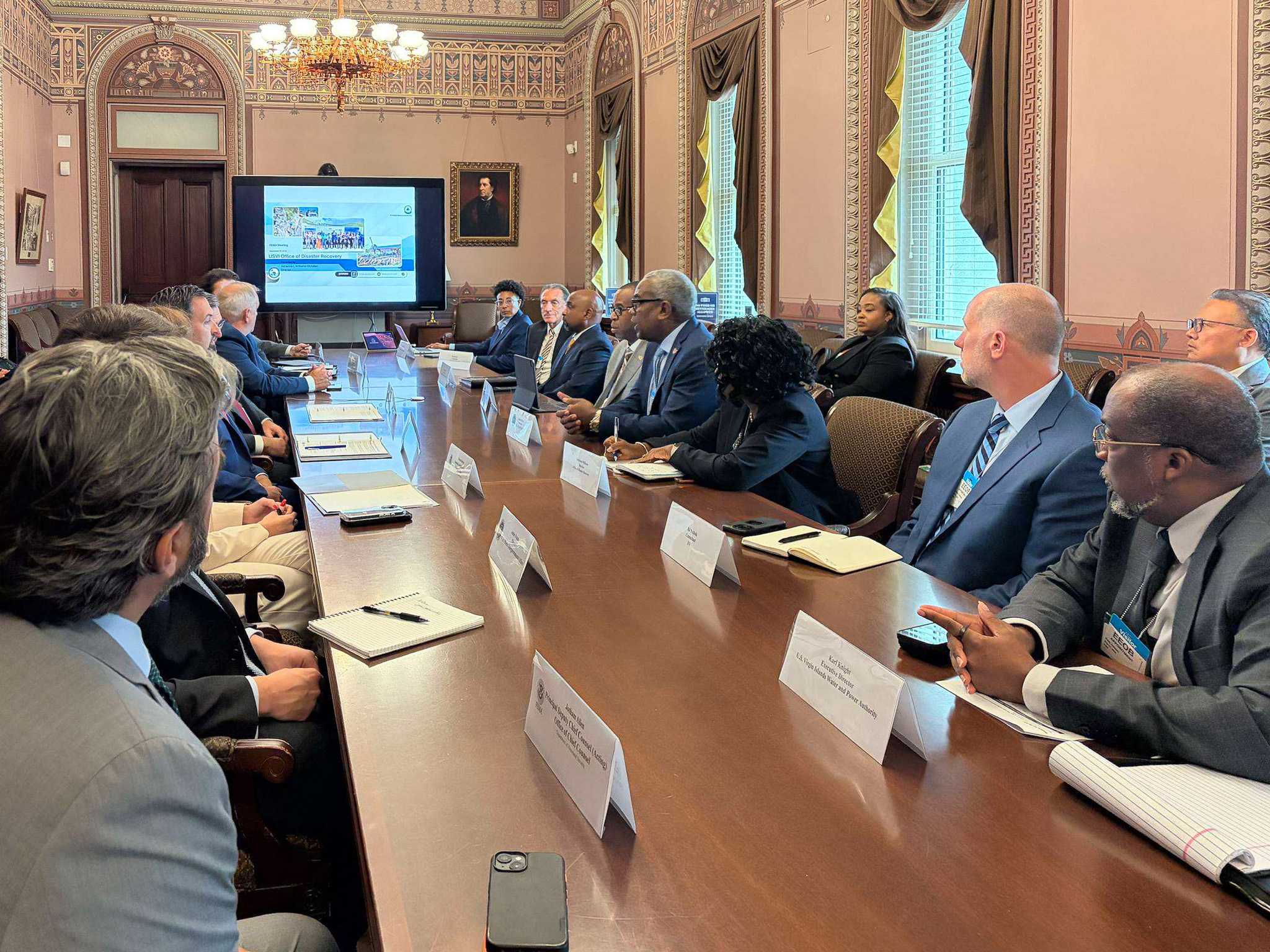
U.S. VIRGIN ISLANDS — Governor Albert Bryan Jr. and senior Government of the Virgin Islands officials met Monday with representatives of the White House Office of Management and Budget and the Federal Emergency Management Agency to review the Territory’s disaster recovery progress and identify opportunities to accelerate the delivery of major projects.
The Virgin Islands delegation presented the Territory’s recovery execution strategy, including the status of major projects, federal funding obligations and the construction schedule anticipated over the next several years.
Joining Governor Bryan were Virgin Islands Office of Disaster Recovery Director and Governor’s Authorized Representative Adrienne L. Williams-Octalien; Acting Territorial Public Assistance Officer Tamisha Lambert; Virgin Islands Water and Power Authority Chief Executive Officer Karl Knight; Virgin Islands Housing Finance Authority Executive Director Derek Gabriel; and other members of the Territory’s recovery team.
The presentation underscored the unprecedented scale of the recovery. FEMA Public Assistance obligations to the Virgin Islands grew from approximately $2.3 billion in September 2020 to approximately $21.6 billion by September 2025, representing federal funding committed to approved recovery projects.
Major obligations were approved in stages, beginning with the first school and healthcare projects in early 2022 and followed by additional hospital, wastewater, school, road, water and power projects through January 2025. Those timelines have shaped when the Territory’s largest projects could advance through procurement, design, environmental review and construction.
Through the Rebuild USVI initiative, the Territory has released 11 procurement bundles, along with additional individual project solicitations, and has executed 12 contracts covering 39 projects supported by approximately $13.7 billion in obligated funding.
“The Virgin Islands has moved from getting the money to putting that money to work,” Governor Bryan said. “For years, the focus was developing projects, negotiating costs, satisfying federal requirements and securing the obligations needed to rebuild. Today, major projects are contracted and advancing through design, environmental review and construction. Our focus now is execution.”
The Territory projects 19 major projects in active construction during 2026, increasing to 42 in 2027 and reaching 46 projects under construction simultaneously in 2028. Significant construction activity is expected to continue through 2030 and beyond.
The recovery portfolio spans St. Croix, St. Thomas and St. John and includes schools, hospitals and healthcare facilities, power generation, water and wastewater systems, roads and public buildings.
Among the major investments highlighted were education projects estimated at approximately $2.4 billion on St. Thomas and $769 million on St. Croix; infrastructure bundles estimated at approximately $4.1 billion in northcentral St. Croix and $4.4 billion in eastern St. Thomas; approximately $1.2 billion in St. Thomas healthcare projects; and approximately $885 million in power generation projects on St. Croix and St. Thomas.
OMB and FEMA officials discussed the pace of expenditures and emphasized the importance of continued measurable progress. The Virgin Islands delegation outlined several factors affecting project delivery in a small island jurisdiction, including skilled labor and workforce housing shortages, contractor availability, construction capacity, debris disposal, inflation, market conditions and environmental permitting.
Federal officials expressed a willingness to work with the Territory to address those barriers, including exploring workforce housing opportunities and facilitating environmental review processes.
Approximately $12 billion in projects are currently moving through environmental compliance processes, making timely coordination with FEMA a significant factor in maintaining construction schedules.
“We welcome the commitment from OMB and FEMA to work with us on the barriers that can affect the pace of delivery,” Governor Bryan said. “We understand the expectation to spend these funds and demonstrate progress, and we share that urgency. Moving billions of dollars in projects through environmental review, design and construction requires close and consistent coordination between the Territory and our federal partners.”
The meeting also addressed local cost-share requirements. The Territory outlined enhanced federal cost shares of 95 percent for standard projects and 98 percent for Section 428 projects, leaving local shares of 5 percent and 2 percent, respectively. Governor Bryan emphasized that the reduced local match has been critical to the Territory’s ability to advance major recovery projects.
The Administration also stressed that accelerating expenditures must be matched by strong financial oversight and compliance. ODR and the Virgin Islands Territorial Emergency Management Agency apply financial and compliance reviews, documentation requirements and physical site inspections as part of the recovery payment process.
The presentation noted that FEMA monitored approximately $1.4 billion, or 42 percent, of the Territory’s $3.28 billion in drawdowns from 2017 through 2024.
“We have three responsibilities: get the funds, spend the funds and spend the funds correctly,” Governor Bryan said. “Speed matters, but so do accountability and compliance. Our goal is to move this recovery as quickly as possible while ensuring that every federal dollar is properly accounted for and ultimately delivers a lasting benefit to the people of the Virgin Islands.”
OMB requested additional project-level information on the current status of recovery projects. The Government of the Virgin Islands expects to provide that information by the end of September and will continue providing regular updates on project execution and expenditures.
Governor Bryan described the meeting as productive and said the Administration will continue working with OMB, FEMA and other federal partners to remove barriers and move recovery investments into construction and completed infrastructure.
“This is the largest rebuilding effort in the history of the Virgin Islands,” Director Williams-Octalien said. “The work ahead is enormous, but the projects are moving. Our responsibility now is to maintain that momentum, resolve challenges as they arise and turn this historic investment into stronger schools, hospitals, utilities, roads and communities for generations of Virgin Islanders.”
###
Comments are closed